Paradise Lost
September 20, 2026 — John Milton
Review
Really good! I find that I do not have complicated thoughts. I bought this copy of The Portable Milton from Vintage at some long past point and it sat on my shelf for ages. Some time ago I removed it from my shelf and, decided I’d never read it, put it on the “to little free library” table. By some cosmic chance I then saw the painting Pandemonium by John Martin:
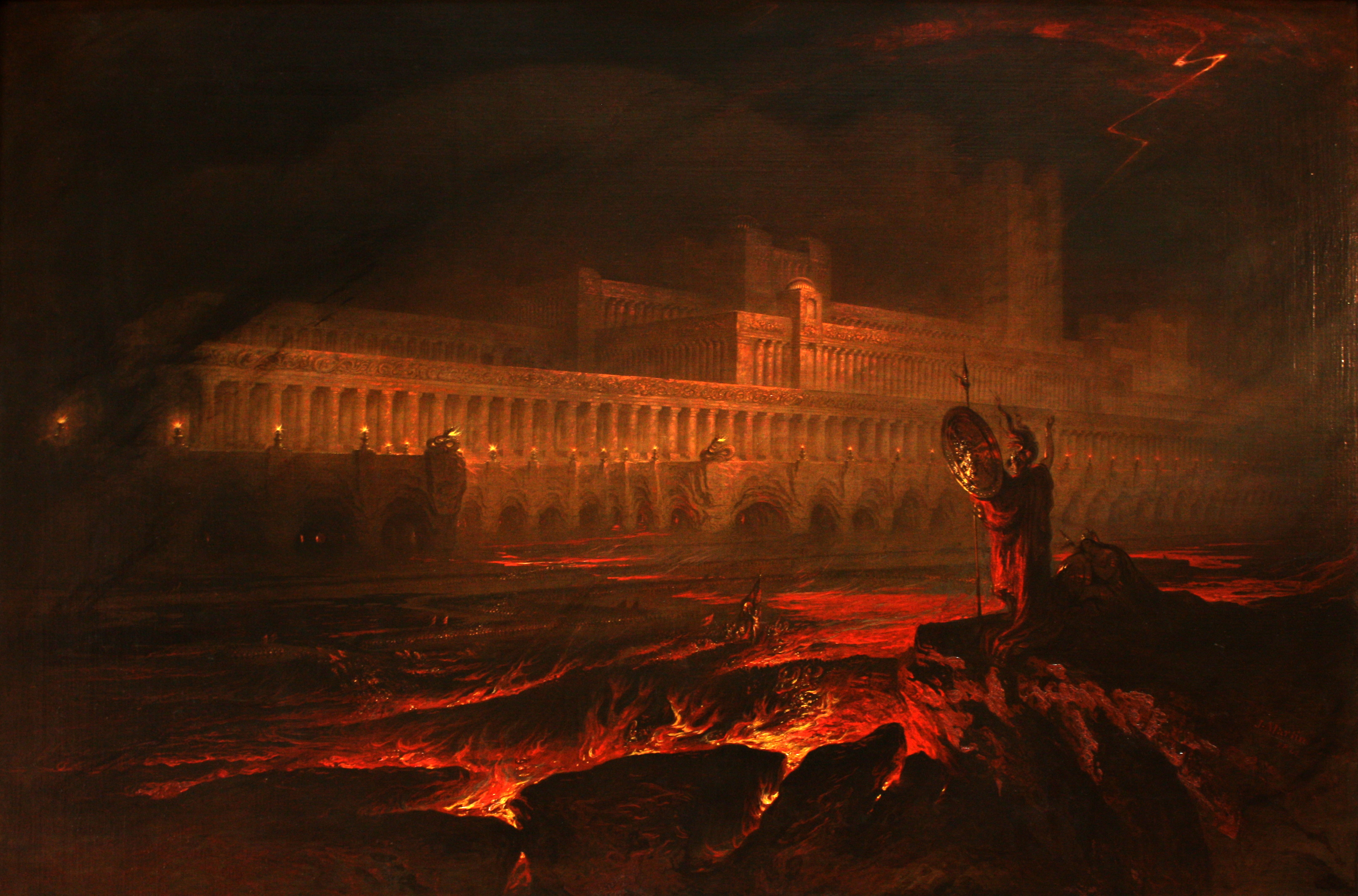
Looks sick, no? So I picked the book up on my way to work and went to reading.
I found it took a while to read, but is another book helped by reading out loud. When I read that Milton, blind, dictated the book, that made a lot of sense to me. It reads very well. There are some more or less boring parts (the final Book in particular did little for me), but the stuff in Hell and Eden is pretty good.
You know who gets a bad rap in this tale? Eve. Geez, as soon as she eats that apple they really treat her like shit. Everything is woman’s folly, I mean they’re a step away from calling her a dopey mare. Clearly, no one was there to hear Satan, because he made good points! Similar to the Old Testament, God comes off as real twat.
Over and over, Adam and Eve (really, Adam, the angels rarely if ever deign to talk to Eve) are told more or less to mind their own business and just thank their lucky stars:
Solicit not thy thoughts with matters hid; Leave them to God above, him serve and fear; Of other creatures, as him pleases best, Wherever placed, let him dispose; joy though In what he gives to thee, this Paradise And thy fair Eve; Heaven is not for thee too high To know what passes there; be lowly wise: Think only what concerns thee and thy being; Dream not of other worlds, what creatures there Live, in what state, condition, or degree, Contended that thus far hath been revealed not of Earth only but of highest Heaven.(page 419)
I would not respond well to this. If God gets to be a busybody knowitall, why can’t I?
I could write some longer more thoughtful review but there really isn’t any point, it’s Paradise Lost.
Notes
Page numbers are from the Vintage Portable Milton.
- p237 - “Fallen Cherub, to be weak is miserable, Doing or suffering: but of this be sure, To do aught good never will be our task, But ever to do ill our sole delight, As being the contrary to his high will Whom we resist. If then his providence Our evil seek to bring forth good, Our labor must be to pervert that end, And out of good still to find means of evil; ”
- p240 - The mind is its own place, and in itself Can make a Heaven of Hell, a Hell of Heaven. What matter where, if I be still the same, And what I should be, all but less than he Whom thunder hath made greater?
- p245 - For spirits when they please Can either sex assume, or both; so soft Not tied or manacled with joint or limb, Nor founded on the brittle strength of bones, Like cumbrous flesh; but in what shape they choose, Dilated or condensed, bright or obscure, Can execute their airy purposes, And works of love or enmity fulfil.
- p251 - . . .we know, and know our own, So as not either to provoke, or dread New war, provoked; our better part remains To work in close design, by fraud or guile, What force effected not; that he no less At length from us may find, who overcomes By force, hath overcome but half his foe.
- p252 - Let none admire That riches grow in Hell; that soil may best Deserve the precious bane. And here let those Who boast in mortal things, and wondering tell of Babel, and the works of Memphian kings, Learn how their greatest monuments of fame, And strength and art are easily outdone By spirits reprobate, and in an hour What in an age they with incessant toil And hands innumerable scarce perform.
- p257-258 - He ceased, and next him Moloch, sceptered king, Stood up, the strongest and the fiercest spirit That fought in Heaven, now fiercer by despair. His trust was with the Eternal to be deemed Equal in strength, and rather than be less Cared not to be at all; with that care lost Went all his fear: of God, or Hell, or worse He recked not, and these words thereafter spake…
- p264 - . . . Of splendid vassalage, but rather seek Our own good from ourselves, and from our own Live to ourselves, though in this vast recess Free, and to none accountable, preferring Hard liberty before the easy yoke Of servile pomp. Our greatness will appear Then most conspicuous when great things of small, Useful of hurtful, prosperous of adverse We can create, and in what place soe’er Thrive under evil, and work ease out of pain Through labor and endurance.
- p273 - . . . Lethe, the river of oblivion, rolls Her watery labyrinth, whereof who drinks Forthwith his former state and being forgets, Forgets both joy and grief, pleasure and pain.
- p274 - They ferry over this Lethean sound Both to and fro, their sorrow to argument, And wish and struggle, as they pass, to reach The tempting stream, with one small drop to lose In sweet forgetfulness all pain and woe, All in one moment, and so near the brink; But Fate withstands, and to oppose the attempt Medusa with Gorgonian terror guards The ford, and of itself the water flies All taste of living wight, as once it fled The lip of Tantalus.
- p282 - Thus saying, from her side the fatal key, Sad instrument of all our woe, she took; And towards the gate rolling her bestial train, Forthwith the huge portcullis high up drew, Which but herself not all the Stygian powers Could have moved; then in the key-hold turns The intricate wards, and every bolt and bar Of massy iron or solid rock with ease Unfastens.
- p283 - Into this wild abyss, The womb of Nature and perhaps her grave, Of neither sea, nor shore, nor air, nor fire, But all these in their pregnant causes mixed Confusedly, and which thus must ever fight, Unless the Almighty Maker them ordain His dark materials to create more worlds, Into this wild abyss the wary Fiend Stood on the brink of Hell and looked a while, Pondering his voyage; for no narrow frith He had to cross.
- p292 - So without lease impulse or shadow of fate, Or aught by me immutably foreseen, They trespass, authors to themselves in all, Both what they judge and what they choose; for so I formed them free, and free they must remain, Till they enthrall themselves: I else must change Their nature, and revoke the high decree Unchangeable, eternal, which ordained Their freedom; they themselves ordained their fall.
- p293 - To whom the great Creator thus replied: “O Son, in whom my would hath chief delight, Son of my bosom, Son who art alone My word, my wisdom, and effectual might, All hast thou spoken as my thoughts are, all As my eternal purpose hath decreed: Man shall not quite be lost, but saved who will Yet not of will in him, but grace in me Freely vouchsafed; once more I will renew His lapsed powers, though forfeit and enthralled By sin to foul exorbitant desires; Upheld by me, yet once more he shall stand On even ground against his mortal foe, By me upheld, that he may know how frail His fallen condition is, and to me owe All his deliverance, and to none but me.”
- p308 - So spake the false dissembler unperceived; For neither man nor angel can discern Hypocrisy, the only evil that walks Invisible, except to God alone, By his permissive will, through Heaven and Earth; And oft though wisdom wake, suspicion sleeps At wisdom’s gate, and to simplicity Resigns her charge, while goodness thinks no ill Where no ill seems: which now for once beguiled Uriel, though regent of the sun, and held The sharpest-sighted spirit of all in Heaven, . . .
- p311 - . . . horror and doubt distract His troubled thoughts, and from the bottom stir The Hell within him, for within him Hell He brings, and round about him, nor from Hell One step no more than from himself can fly By change of place. Now conscience wakes despair That slumbered, wakes the bitter memory Of what he was, what is, and what must be Worse; of worse deeds worse sufferings must ensue.
- p313 - But Heaven’s free love dealt equally to all? Be then his love accurst, since love or hate, To me alike, it deals eternal woe. Nay cursed be thou, since against his thy will Chose freely what it now so justly rues. Me miserable! which way shall I fly Infinite wrath, and infinite despair? Which way I fly is Hell; myself am Hell; And in the lowest deep a lower deep Still threatening to devour me opens wide.
- p317 - So little knows Any, but God alone, to value right The good before him but perverts best things To worst abuse, or to their meanest use.
- p326 - All is not theirs, it seems; One fatal tree there stands, of Knowledge called, Forbidden them to taste. Knowledge forbidden? Suspicious, reasonless. Why should their Lord Envy them that? can it be sin to know, Can it be death? and do they only stand By ignorance, is that their happy state, The proof of their obedience and their faith? O fair foundation laid whereon to build Their ruin! Hence I will excite their minds With more desire to know, and to reject Envious commands, invented with design To keep them low whom knowledge might exalt Equal with Gods. Aspiring to be such, They taste and die; what likelier can ensue?
- p343 - But he thus, overjoyed: ‘O fruit divine, Sweet of thyself, but much more sweet thus cropped, Forbidden here, it seems, as only fit For gods, yet able to make gods of men; And why not gods of men, since good, the more Communicated, more abundant grows, The author not impaired, but honored more? . . .’
- p361 - But not so waked Satan—so call him now, his former name Is heard no more in Heaven; he of the first, If not the first Archangel, great in power, In favor, and pre-eminence, yet fraught With envy against the Son of God, that day Honored by his great Father, and proclaimed Messiah, King anointed, could not bear Through pride that sight, and thought himself impaired.
- p362 - . . . but all obeyed The wonted signal, and superior voice Of their great Potentate; for great indeed His name, and high was his degree in Heaven; His countenance, as the morning star that guides The starry flock, allured them, and with lies Drew after him the third part of Heaven’s host.
- p372 - “‘O Heaven! that such resemblance of the Highest Should yet remain, where faith and realty Remain not; wherefore should not strength and might There fail where virtue fails, or weakness prove Where boldest, though to sight unconquerable? . . .’”
- p373 - My sect though seest; now learn too late How few sometimes may know, when thousands err.
- p374 - To heavenly souls had been all one; but now I see that most through sloth had rather serve, Ministering spirits, trained up in feast and song; Such hast thou armed, the minstrelsy of Heaven, Servility with freedom to contend, As both their deeds compared this day shall prove.
- p381 - Of evil then so small, as easy think The remedy: perhaps more valid arms, Weapons more violent, when next we meet, May serve to better us, and worse our foes, Or equal what between us made the odds, In nature none. If other hidden cause Left them superior, while we can preserve Unhurt our minds, and understanding sound, Due search and consolation will disclose.
- p383 - Yet haply of thy race In future days, if malice should abound, Some one intent on mischief, or inspired With devilish machination, might devise Like instrument to plague the sons of men For sin, on war and mutual slaughter bent.
- p399 - To ask, nor let thine own intentions hope Things not revealed, which the invisible King, Only omniscient, hath suppressed in night, To none communicable in Earth or Heaven: Enough is left besides to search and know. But knowledge is as food, and needs no less Her temperance over appetite, to know In measure what the mind may well contain, oppress else with surfeit, and soon turns Wisdom to folly, as nourishment to wind.
- p414 - Adam inquires concerning celestial motions, is doubtfully answered, and exhorted to search rather things more worthy of knowledge.
- TB: God’s a shit in this book (the Bible too).
- p419 - Solicit not thy thoughts with matters hid; Leave them to God above, him serve and fear; Of other creatures, as him pleases best, Wherever placed, let him dispose; joy though In what he gives to thee, this Paradise And thy fair Eve; Heaven is not for thee too high To know what passes there; be lowly wise: Think only what concerns thee and thy being; Dream not of other worlds, what creatures there Live, in what state, condition, or degree, Contended that thus far hath been revealed not of Earth only but of highest Heaven.
- p439 - O foul descent! that I who erst contended With Gods to sit the highest, am now constrained Into a beast, and mixed with bestial slime, This essence to incarnate and imbrute, That to the height of deity aspired; But what will not ambition and revenge Descend to? Who aspires must down as low As high he soared, obnoxious first or last To basest things. Revenge, at first though sweet, Bitter ere long back on itself recoils; Let it; I reck not, so it light well aimed, Since higher I fall short, on him who next Provokes my envy, this new favorite Of Heaven, this man of clay, son of despite, Whom us the more to spite his Maker raised From dust: spite the with spite is best repaid.
- p440 - Thou therefore now advise Or hear what to my mind first thoughts present: Let us divide our labors, thou where choice Leads thee, or where most needs, whether to wind The woodbine round this arbor, or direct The clasping ivy where to climb, while I In yonder spring of roses intermixed With myrtle, find that to redress till noon.
- p455 - If they all things, who enclosed Knowledge of good and evil in this tree, That whoso eats thereof, forthwith attains Wisdom without their leave? and wherein lies The offense, that man should thus attain to know? What can your knowledge hurt him, or this tree Impart against his will, if all be his? Or is it envy, and can envy dwell In heavenly breasts? These, these and many more Causes import your need for this fair fruit. Goddess humane, reach then, and freely taste!
- p476 - Nor he their outward only with the skins Of beasts, but inward nakedness, much more Opprobrious, with his robe of righteousness Arraying, covered from his Father’s sight.
- p492 - Yet one doubt Pursues me still, lest all I cannot die, Lest that pure breath of life, the spirit of man Which God inspired, cannot together perish With this corporeal clod; then in the grave Or in some other dismal place, who knows But I shall die a living death? O thought Horrid, if true! Yet why? It was but breath Of life that sinned; what dies but what had life And sin? the body properly had neither. All of me then shall die: let this appease The doubt, since human reach no further knows.
- p494 - “Why comes not Death,” Said he, “with one thrice-acceptable stroke To end me? Shall Truth fail to keep her word, Justice divine not hasten to be just? But Death comes not at call, Justice divine Mends not her slowest pace for prayers or cries.”
- p525 - “. . . But I was far deceived; for now I see Peace to corrupt no less than war to waste. How comes it thus? unfold, celestial guide, And whether here the race of man will end.”
- p535 - The race elect Safe towards Canaan from the shore advance Through the wild desert, not the readiest way, Lest entering from the Canaanite alarmed War terrify them inexpert, and fear Return them back to Egypt, choosing rather Inglorious life with servitude; for life To noble and ignoble is more sweet Untrained in arms, where rashness leads not on.